Impact of 50% Tariffs on Indian Businesses: A Comprehensive Blog Analysis
Unpacking the seismic trade rift between the US and India, this blog post navigates the far-reaching repercussions of 50% tariffs on Indian goods, delving into sector-specific disruptions, economic tremors, and forecasts for both nations, amidst warnings of a significant GDP growth slowdown, from 6.3% to 6%, and a potential $30-35 billion export risk, as leading institutions like Moody's, Goldman Sachs, and Morgan Stanley weigh in on the impending economic fallout.
The decision by US President Donald Trump to impose 50% tariffs on Indian goods marks a significant escalation in trade tensions between the world’s largest and fifth-largest economies. This blog dives into the wide-ranging effects on Indian businesses, explores sector-specific impacts, considers consequences for the United States, and offers predictions based on historical trends and current economic forecasts.

Economic Shockwaves and GDP Outlook
The 50% tariffs threaten India’s economic growth, with leading institutions projecting a GDP growth reduction of 0.3 to 1.0 percentage points. Moody’s estimates a drop from 6.3% to around 6% for fiscal 2025–26. Goldman Sachs has adjusted India’s real GDP growth to 6.5% for 2025 and 6.4% for 2026, while Morgan Stanley warns of a direct hit of 0.6% to GDP, with indirect effects potentially doubling the impact to 1.2% over a year. UBS highlights that $30–35 billion of India’s merchandise exports to the US are at risk, potentially shaving nearly a full percentage point off GDP growth over two years. Bloomberg Economics paints a bleaker picture, suggesting a possible 60% cut in US-bound exports, leading to a 0.9% GDP decline.

Sector-Specific Fallout
Hardest-Hit Industries
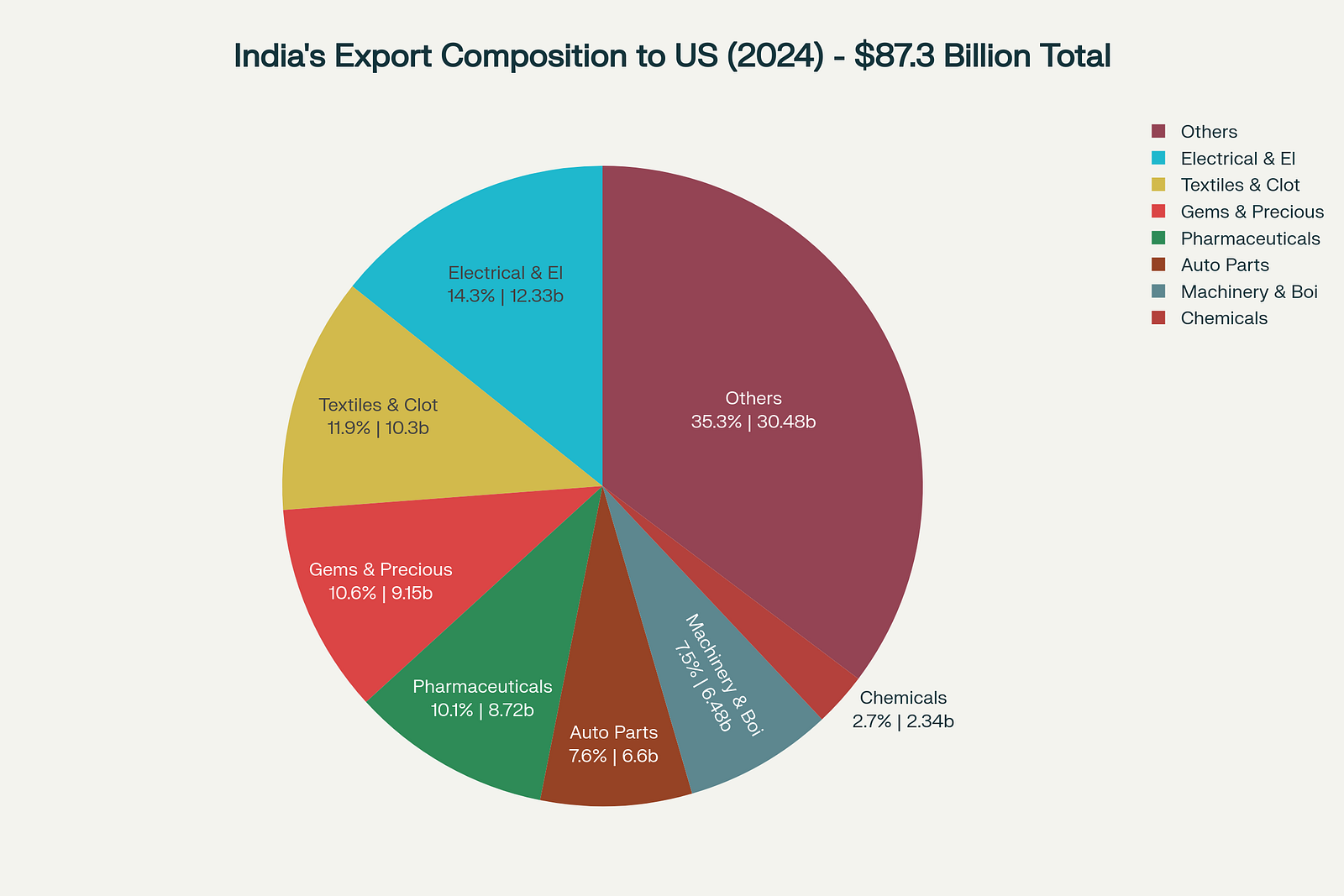
Labor-intensive sectors, critical to India’s export economy, face severe challenges. The textile and clothing industry, with $10.3 billion in exports, is reeling, with industry leaders calling the tariffs “worse than COVID.” The Confederation of Indian Textile Industry notes a significant competitive disadvantage against countries like Vietnam and Bangladesh.
The gems and jewelry sector, India’s largest export category to the US at $12 billion annually, faces a 52.1% effective tariff rate, making many exports unviable and creating a 30–35% competitive gap compared to other nations.
Auto components, valued at $6.6 billion, see nearly half of their US exports hit with 50% duties, disrupting a sector where the US accounts for one-third of global trade.
Moderately Impacted Sectors
The chemicals industry, with $2.34 billion in exports, faces a 54% tariff rate. Machinery and equipment exports, worth $9 billion, encounter 51.3% duties. Shrimp and seafood, valued at $2.24 billion, face combined duties of 33.26% when factoring in existing anti-dumping measures.
Sectors Spared (For Now)
Pharmaceuticals ($8.72 billion) and electronics ($12.33 billion) are currently exempt from additional tariffs under Section 232 investigations. However, Trump’s threat of 250% tariffs on pharmaceuticals looms, creating uncertainty.
Manufacturing and Jobs at Risk
The tariffs jeopardize India’s “Make in India” initiative, which aims to position the country as a global manufacturing hub. Moody’s warns that the tariff gap with other Asia-Pacific nations could derail ambitions in high-value sectors like electronics. Labor-intensive industries like textiles, operating on slim 5–10% margins, are particularly vulnerable, with small and medium enterprises (MSMEs) facing acute risks due to limited financial resilience.

Companies are adapting swiftly:
- Gokaldas Exports is ramping up production in Kenya and Ethiopia, where US duties are only 10%.
- Titan Ltd is exploring relocating jewelry production to the Middle East.
- Alembic Pharmaceuticals and Aurobindo Pharma are eyeing US acquisitions to bolster local manufacturing.
Ripple Effects in the United States
The tariffs will also hit the US economy hard. Consumer price inflation is expected to rise by 0.8–1.2 percentage points as costs pass through to consumers. US GDP growth could dip by 0.4–0.6 percentage points due to inefficiencies and higher production costs. The Federal Reserve may delay rate cuts as inflation pressures build. America’s reliance on Indian generic medicines — nearly half of its supply — heightens risks of healthcare cost spikes and supply chain disruptions, with manufacturing costs potentially rising 15–25%.
US consumers will feel the pinch in:
- Healthcare, due to India’s role in generic drug supply.
- Technology products, despite current exemptions.
- Textiles, apparel, jewelry, and luxury goods, as alternative suppliers charge more.
Lessons from Past Trade Wars
The US-India tariff spat echoes the 2018–2020 US-China trade war, which involved 25–30% tariffs on $550 billion in trade but ultimately led to a partial deal. The current dispute, while smaller in scale ($87 billion), features higher 50% tariffs. The US-China experience showed supply chain shifts, GDP losses, and prolonged negotiations with limited success in reducing trade deficits.
India’s past trade tensions with the US, like the 2018–2019 steel and aluminum tariffs and GSP removal, suggest a pattern of measured retaliation, extended talks, and eventual compromises driven by long-term strategic partnerships.
What Lies Ahead
Short-Term Scenarios (3–12 Months)
- Best Case (25% chance): Swift diplomatic talks could limit GDP impact to 0.1 percentage points, with India conceding on energy procurement and the US lowering tariffs to 15–20%.
- Most Likely (40% chance): A partial deal within a year reduces tariffs but maintains some penalties, with a 0.5% GDP hit.
- Worst Case (20% chance): Full 50% tariffs persist for two years, cutting GDP by 1.0% and forcing major supply chain overhauls.
Medium-Term Strategies (1–3 Years)
India’s response will likely emphasize:
- Market diversification to the EU, UK, and Asia-Pacific.
- Supply chain resilience through domestic production.
- Sectoral support to protect industries and workers.
- Manufacturing reforms to cut costs and boost competitiveness.
Long-Term Shifts (3–5 Years)
The tariffs could spark lasting changes:
- For India: Faster domestic manufacturing growth, focus on services exports, stronger South-South trade, and greater trade policy autonomy.
- For the US: Higher inflation, reduced access to cost-effective Indian goods, and strained ties with allies.
- Globally: Fragmented supply chains, stronger regional trade blocs, and a shift toward economic security over efficiency.
Expert Insights
- Manufacturing: Companies may move production to countries like Mexico or Vietnam with better US trade terms.
- Tech and Pharma: Despite exemptions, Trump’s 250% tariff threat could push Indian firms to build US facilities.
- Services: India’s IT and outsourcing sectors may gain as companies seek cost savings to offset tariff-driven losses.
Policy and Industry Playbook
For India’s Government
- Engage diplomatically to negotiate tariff reductions while protecting agriculture and dairy.
- Offer economic support like export incentives and skill programs for affected sectors.
- Diversify markets to reduce US reliance.
- Boost manufacturing competitiveness through infrastructure and regulatory reforms.
For Businesses
- Shift production to countries with lower US tariffs.
- Integrate value chains to improve margins.
- Differentiate products to reduce price sensitivity.
- Lobby for government support tailored to specific sectors.
Final Thoughts
The 50% US tariffs pose a formidable challenge to India’s export-driven growth, potentially shaving 0.3–1.0% off GDP, with textiles, gems, jewelry, and auto components bearing the brunt. Yet, India’s domestic-focused economy offers a buffer. This crisis could catalyze structural reforms, boosting manufacturing competitiveness and market diversification. Historical trade disputes suggest short-term pain but long-term resilience through diplomacy and compromise. India’s ability to balance autonomy with pragmatic engagement will determine its success in navigating this trade storm and emerging stronger in a shifting global economy.